






Industrial processes require robust and reliable technologies. In contrast to conventional desktop PCs, industrial PCs are specially developed for use in demanding environments. In this article, you will learn about the advantages of industrial PCs and why they are particularly suitable for companies that rely on uninterrupted production.
When should you use an industrial PC?
Industrial PCs are used in particular when there are demanding environmental conditions and specific requirements. They are suitable for applications with challenging conditions such as high temperatures, humidity or strong vibrations. They are also the right choice when high reliability is required, for example in production plants or when controlling critical processes. A further advantage can be seen in scenarios where a long life cycle is required, for example in systems that are operated over many years. Finally, industrial PCs are used when there are special requirements for interfaces and functions, as is often the case in automation technology.
Typical areas of application for industrial PCs:
- Automation technology: control of production systems, robots and machines
- Mechanical engineering: integration in CNC machines, measuring devices and test benches
- Medical technology: use in medical devices and diagnostic systems
- Traffic engineering: control of traffic management systems and railroad technology
- Energy technology: monitoring and control of energy generation systems
Industrial PCs in focus
Industrial PCs and standard PCs differ fundamentally in their orientation and area of application. While standard PCs were mainly developed for office applications, private use and entertainment, industrial PCs are specially designed for use in demanding environments and for industrial applications.
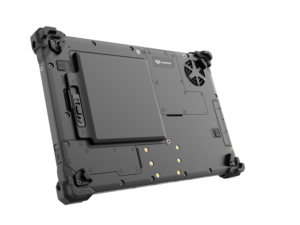
A key difference lies in their robustness. Industrial PCs are more resistant to influences such as vibrations, extreme temperatures, dust or moisture. They are usually housed in sturdy enclosures and have additional protective measures such as special coatings or seals. They often meet IP protection classes such as IP65, IP67 or higher to ensure reliable operation in difficult environments. These protection classes guarantee protection against dust and the ingress of water, for example, even in the event of temporary immersion.
Another aspect is durability. Industrial PCs are designed for long-term operation and use specially selected, high-quality components such as robust motherboards, long-life capacitors and shock-resistant hard disks or SSDs. They also have efficient cooling systems, special and extremely durable PCAP (Projected Capacitive Touch) touchscreens to ensure reliable performance. These features make them particularly suitable for applications where replacement of devices over long periods of time is to be avoided.
There are also differences in performance. Industrial PCs are often equipped with more powerful hardware to handle complex tasks such as real-time data processing or the control of industrial processes. These hardware components are usually available for several years and thus offer companies longer-term planning when purchasing an industrial PC.
Industrial PCs also offer extended functionalities and extensive customization options. They can be equipped with a variety of interfaces that can be individually installed as required, such as digital inputs and outputs, serial interfaces or specialized communication modules for industrial applications. In addition, memory sizes, processors, display sizes and brightness can be flexibly adapted to meet the specific requirements of the respective application. The external design can also be customized: For example, customers can choose from different housing colors and have their company logo branded directly on the device.
Finally, the devices also differ in terms of the available operating systems. Industrial PCs can be operated with different platforms, including Windows, Linux or special real-time operating systems, to meet the specific requirements of industrial applications. In addition, we offer comprehensive support and individual advice to ensure that each system is optimally matched to the customer’s specific application. Our team of experts will help you find the right hardware solution and integrate it into your existing workflows.
Comparison: Industrial PCs vs. standard PCs
Feature | Industrial PC | Standard PC |
Housing | Robust, often made of metal (stainless steel, aluminum), protection classes such as IP65 or IP69, resistant to vibrations, dust, moisture and extreme temperatures | Plastic housing, susceptible to mechanical damage, not suitable for harsh environments |
Components | High-quality, durable components, often fanless, designed for continuous operation, special interfaces (e.g. for sensors, actuators) | Standard components, often designed for cost optimization, designed for short-term use |
Operating system | Often special operating systems (e.g. real-time operating systems) or customized distributions of Windows or Linux, optimized for industrial applications | Windows or macOS, designed for general applications |
Area of application | Automation technology, mechanical engineering, medical technology, traffic engineering, energy technology, harsh environments, 24/7 operation | Office applications, entertainment, home use, air-conditioned environments |
Service life | Several years to decades | A few years |
Maintenance | Easy maintenance, often modular design, long availability of spare parts | More complex maintenance, shorter availability of spare parts |
Costs | Higher acquisition costs, but lower total cost of ownership due to longer service life and reliability | Lower acquisition costs, but higher total cost of ownership due to frequent breakdowns and shorter service life |
Conclusion:
Industrial PCs impress with their reliability, durability and adaptability, which make them ideal for demanding applications. They are specially designed for continuous operation in difficult environments such as extreme temperatures, high humidity or strong vibrations, thus contributing to process stability.
Thanks to high-quality components and a robust design, they offer a long service life and reduce downtimes, resulting in greater efficiency and lower costs. The flexibility offered by customizable interfaces and expansion options allows them to be tailored precisely to the requirements of industrial applications.
Industrial PCs also score points with security functions to protect sensitive data, energy efficiency to reduce costs and sustainability and a compact design that allows installation even where space is limited. Their modularity enables easy maintenance and upgrades, making them a versatile and future-proof solution for numerous industries.
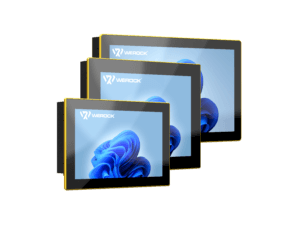
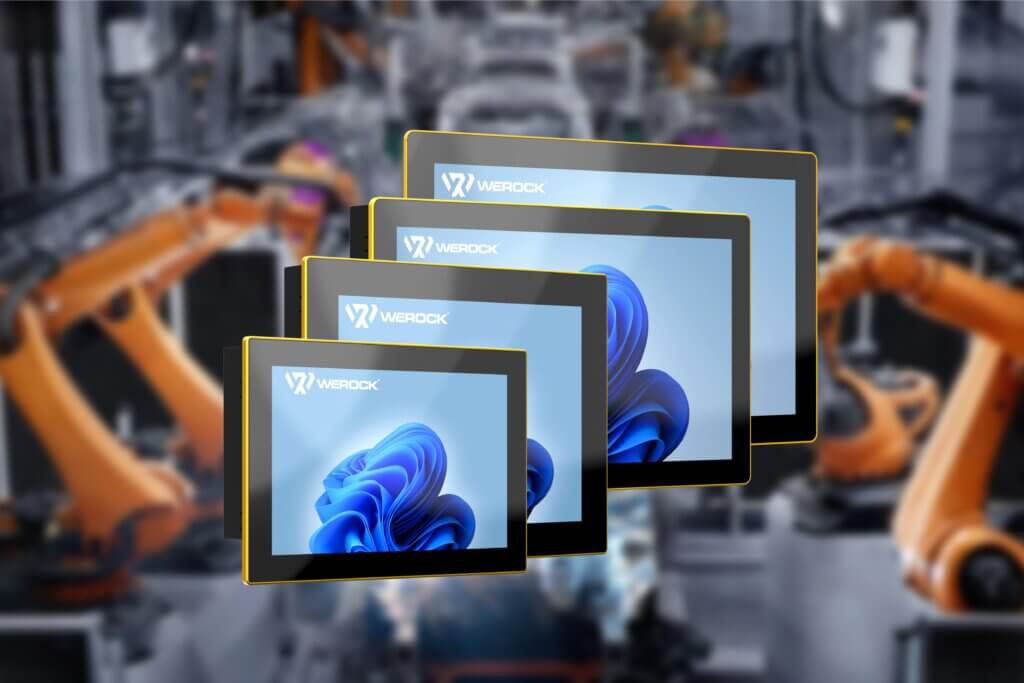
Our Rocksmart RSC600 series industrial panel PCs are available in 4 different display sizes from 10″ to 22″. They are robust, offer a powerful range of functions, are individually configurable and can be adapted to the company’s CI in a desired color and with logo branding.
Let our experts advise you to find out which solution best suits your needs. Contact us today for a free, no-obligation consultation! https://www.werocktools.com/contact
You can find our industrial computer solutions here: https://www.werocktools.com/industrial-computers/