




Background
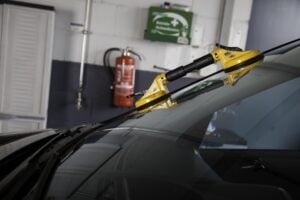
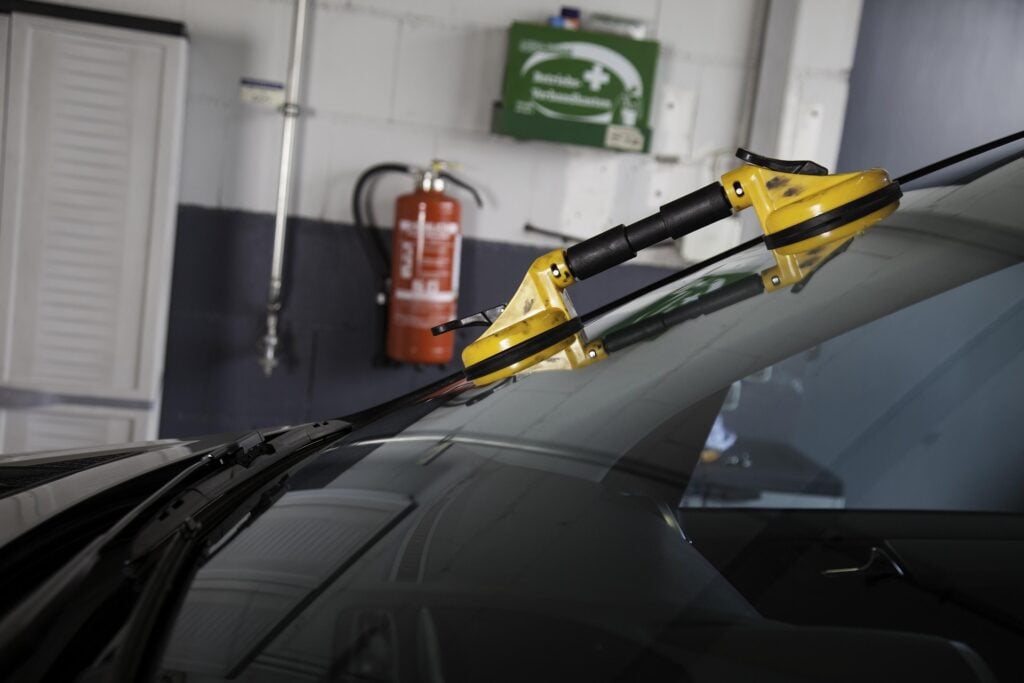
Mobile auto glass repair is a demanding field in which technicians must work under time pressure and in changing environments. One of our customers—an auto glass service company operating throughout Germany—reached out to us. The technicians arrive at the customer’s location in a fully equipped service van and perform calibration, diagnostics, and digital damage assessment directly on-site.
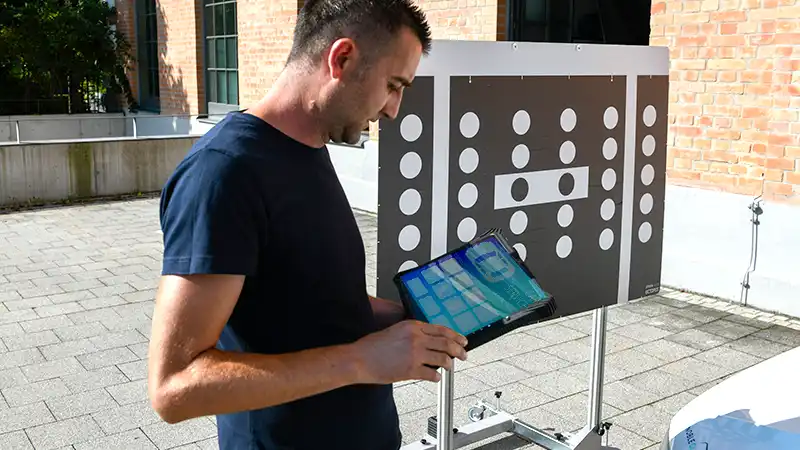
Previously, consumer tablets were used for the technicians, but these proved unsuitable. In the rough and tumble of daily life on the road, malfunctions occurred time and again. At the same time, there was another technical challenge: a USB license dongle was required for critical diagnostic software. This dongle protruded from the device, making it susceptible to damage and, in some cases, lost during daily operations. In some cases, the unprotected design even caused damage to the tablet itself.
The company’s approximately 100 service technicians therefore need reliable, rugged devices that not only withstand the harsh conditions of field service but also support all operational processes. Standard tablets often fail in this context because they are not designed for extreme temperatures, dust, moisture, or mechanical stress. The devices should not only make order data available on the go but also handle additional tasks in daily operations—from digital order processing to supporting vehicle-related calibration processes.
Requirements for the new solution
The existing fleet of Microsoft Surface tablets is to be replaced with a standardized device. Therefore, a solution was sought that meets three requirements simultaneously: high ruggedness for mobile use, sufficient computing power for more demanding applications, and a clean and protected integration of the license dongle.
The tablets should serve as a central tool in day-to-day operations and cover several tasks:
- Retrieving order details directly on-site
- Digital processing of work orders
- Support for calibration work
- General office and communication tasks in the field
In addition to the actual hardware, the implementation process was also important. The devices should be ready for use at the customer’s site with as little additional installation effort as possible, so that new tablets can be distributed directly to the technicians.
Another requirement was to find a solution for the USB license dongle of the specialized software used and to integrate it into the housing in a recessed manner. In the previous solution, it protruded from the housing. For a field service team that is on the road daily, transports devices, works in vehicles, and operates at changing locations, this immediately creates real-world problems:
- mechanical stress on the USB port
- increased risk of loss or breakage of the dongle
- additional risk of damage to the tablet
- impractical handling in daily use
The implemented solution
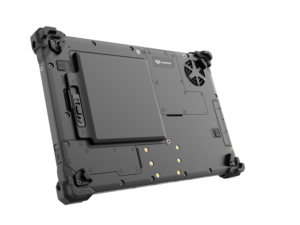
The choice fell on the powerful Rocktab S512. The deciding factors were not only the device’s inherent ruggedness but also the ability to tailor the hardware specifically to the customer’s needs.
The rugged Rocktab S512 tablet comes with all the features field service technicians need: a rugged housing that is fully dust- and waterproof to IP65, as well as military-grade drop protection from a height of 1.2 meters. Practical hooks and eyelets allow accessories such as a wrist strap or shoulder strap to be attached. This significantly improves ergonomics during work. However, even though ruggedness is the primary focus of this device, its performance leaves nothing to be desired. An integrated 12th-generation Intel Core i7 processor and 16 GB of RAM allow for smooth handling of standard office tasks and multitasking.
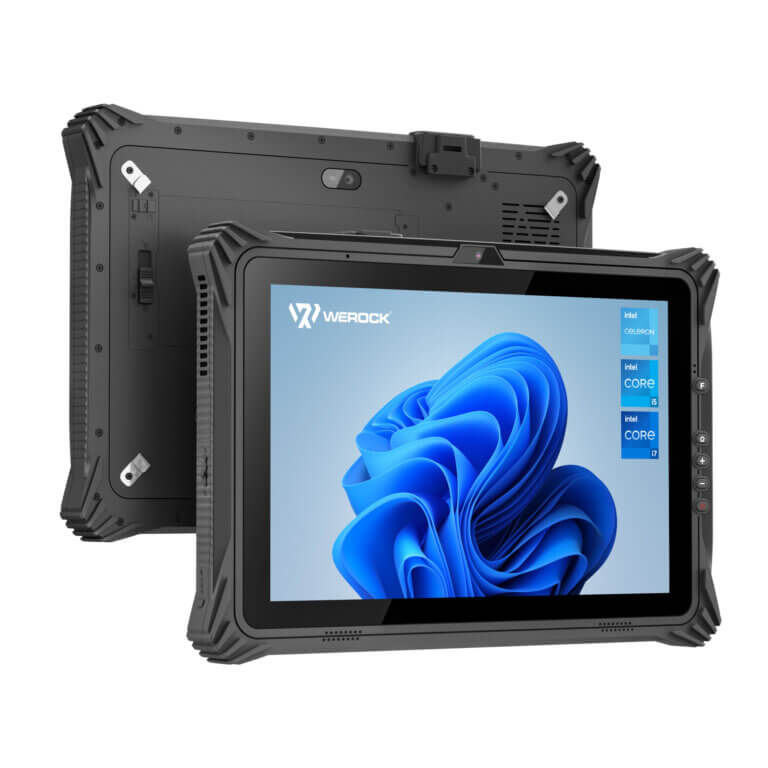
The Rocktab S512 features an expansion slot into which, for example, a LAN port or a barcode scanner can be integrated as standard. For this project, a new USB board was developed into which the Nano USB license dongle could be inserted internally. As a result, the dongle was safely housed inside the device without protruding outward.
The key point here: The outer casing did not need to be modified. The tablet’s robust construction was preserved, as was its IP65 protection. The customer thus received not a makeshift solution, but a cleanly integrated, practical, and durable custom adaptation.
Advantages of Internal Dongle Integration
Internal integration brought several practical advantages.
First, the risk of mechanical damage was significantly reduced. Since the dongle no longer protrudes from the housing, it cannot be easily damaged during transport or while in use.
Second, day-to-day handling became significantly easier. Technicians no longer have to work with a delicate, external add-on that can get lost or snag when getting in and out of the vehicle, during stowage, or during on-site use.
Third, a more professional and robust device platform was created. Instead of a tablet plus an external dongle, field staff now had a closed-system solution tailored to real-world use.
Pre-installation for a quick rollout
In addition to hardware customization, device preparation also played a key role. WEROCK therefore handled the complete preparation of the devices. The customer provided a system image with all pre-installed tools, which WEROCK loaded onto the tablets prior to shipment.
This resulted in a true zero-touch deployment: the customer simply had to insert the dongle, and the tablets could be sent to the technicians immediately without any further installation effort.
This is a significant advantage, especially for a decentralized team. When service technicians are deployed across Germany, every additional manual setup step costs time, ties up internal resources, and delays the rollout. Thanks to the pre-installation, this step could effectively be moved up and handled centrally.
Result: A robust platform for everyday mobile work
What began as a replacement purchase has since evolved into a strategic device standardization initiative. Today, the Rocktab S512 serves as a reliable, all-purpose tool for technicians deployed nationwide, supporting order processing, calibration, and office tasks.
What’s more, the high performance of the Intel Core i7 processor now opens up new possibilities for digitalization for customers. Based on positive experiences in everyday use, the company is currently discussing expanding the hard drive capacities of these models so that even more applications and processes can be offloaded to mobile devices in the future.
Conclusion
Not every industry-specific requirement can be met with standard off-the-shelf hardware. In professional field service, it is often the details—such as the clever, secure integration of a small license dongle—that determine the success and longevity of a work tool. By combining customizable, rugged hardware with preconfigured delivery, the auto glass specialist received a tailor-made solution that perfectly supports real-world workflows.
For companies with mobile service processes, this is exactly what can make the difference: not isolated standard hardware, but a tool tailored to real-world workflows. Feel free to contact us with your requirements for your mobile technicians.