






Data capture technology in the industry has made enormous progress in recent years. Innovative devices help to scan and process information quickly and easily. Two devices that are particularly well suited to this are back of hand scanners and portable scanners. But what exactly are the differences between these two devices and which one is better suited to your needs?
Back of hand scanner - hands-free scanning for maximum flexibility
Back of hand scanners are portable devices that have been specially developed for the efficient scanning of a wide range of data. They are characterised by their ergonomic attachment to the back of the hand, which enables a comfortable hand position and at the same time leaves the hands free for other tasks. They are particularly advantageous in areas where barcodes need to be scanned frequently.
These devices are usually small and lightweight, but offer a powerful scanning engine with a long range that ensures fast and accurate data capture. In order to carry the scanner comfortably and securely on the back of the hand, it is usually offered with various accessories. This allows the scanner to be customised according to requirements and working environment.
The areas of application for backhand scanners are diverse. In warehouse logistics, for example, the scanner enables hands-free scanning during incoming and outgoing goods, which makes the workflow much more efficient. The scanner is also increasingly used when scanning from a forklift truck, as it shortens walking distances and therefore saves time. In production, on the other hand, the back-of-hand scanner helps the work process to run more smoothly, as the scanner no longer has to be constantly picked up and put down. In production in particular, it offers a further advantage: depending on the accessories, the scanner can be worn over work gloves so that it does not hinder work. Finally, in order picking, the hands remain free to carry larger objects while barcodes can be scanned at the same time.

Overall, back-of-hand scanners make work easier in many areas, as they increase both efficiency and user-friendliness.
Advantages of the back of the hand scanner:
- Wireless connection: Most back of hand scanners today connect to the host via Bluetooth, offering additional flexibility at work
- Increased efficiency: Greater efficiency as the workflow is not disrupted by picking up a scanner – the scanner is always to hand
- Ergonomics: The ergonomic hand position prevents hand fatigue even with high scan volumes
- Comfort and user-friendliness: The scanner is easy to use and particularly comfortable thanks to its low weight and convenient accessories
- Various accessories: Mostly available with various accessories – so the optimum holders can be used for all areas of application
- Powerful: The powerful scanners have a long battery life and, depending on the model, a long range
Disadvantages:
- Cost: The scanner’s gloves and accessories are wearing parts and need to be replaced when necessary, which incurs additional costs
- Limited battery power: Depending on the model, the small and lightweight scanners have a rechargeable battery that has to be replaced after a certain period of time. Wired versions, on the other hand, offer absolutely uninterrupted scanning
Product recommendation for backhand scanners:
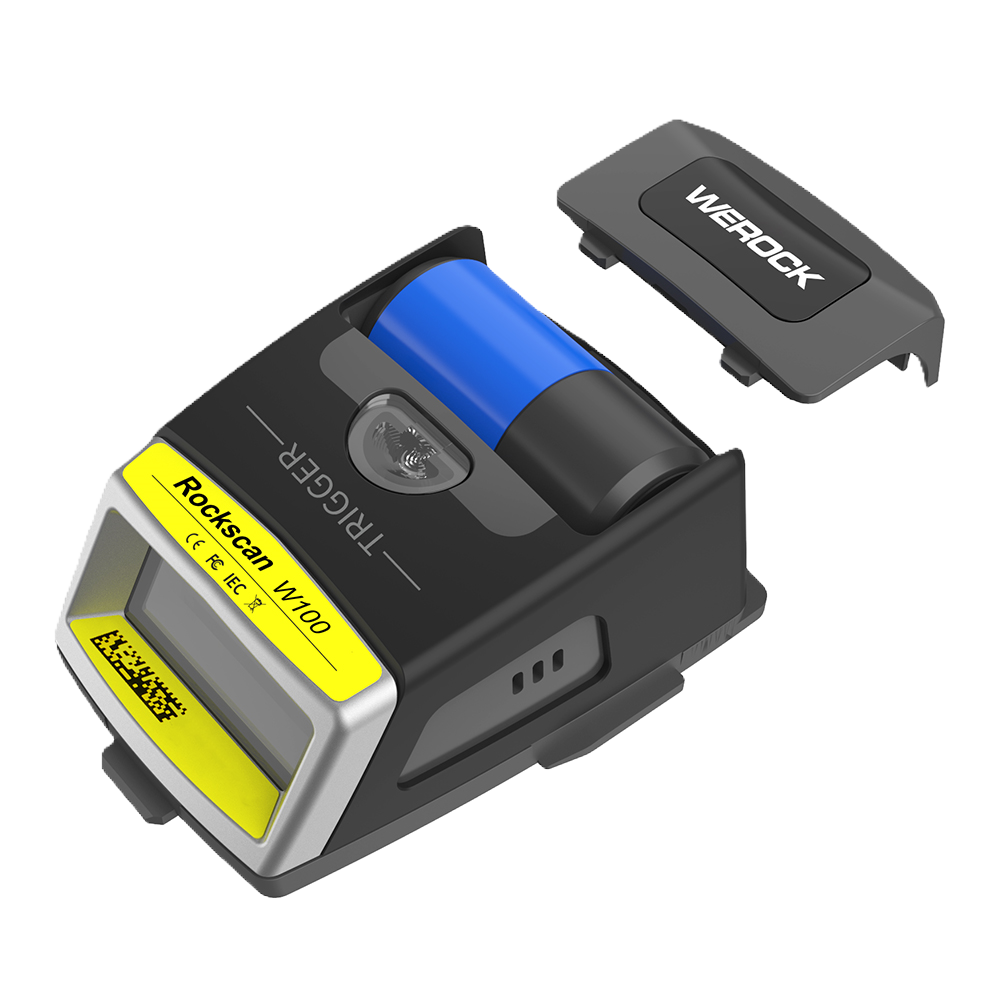
Our robust portable barcode scanner Rockscan W100 can be used as a backhand scanner with the appropriate accessories and was developed for flexible, hands-free scanning in industry and logistics. Find out more about the advantages of our innovative scanners here
Handheld scanners - ultra robust for all applications
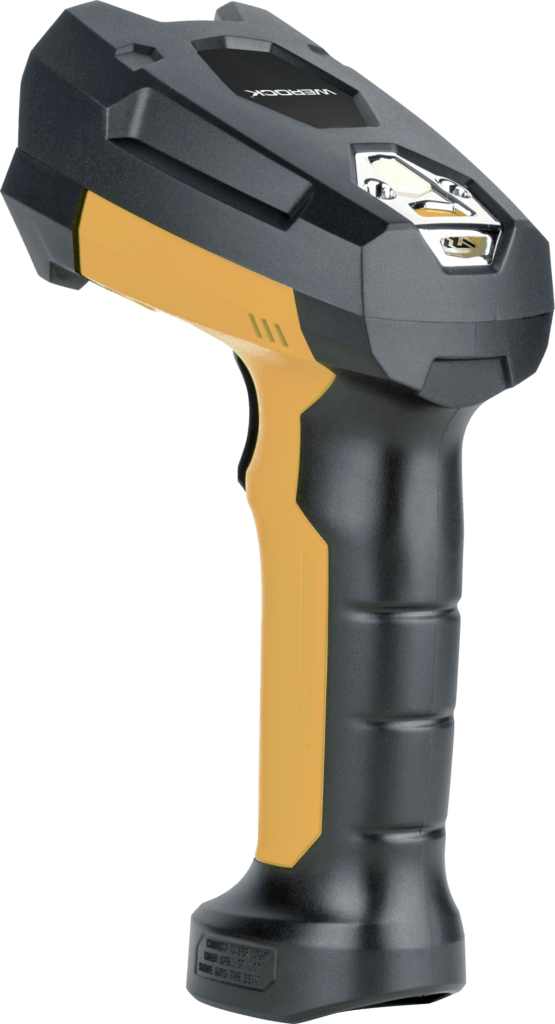
Portable scanners are compact, handy devices that are primarily used in industrial and logistical areas for capturing barcodes. Their robust design makes them an ideal solution for use in challenging environments where speed and reliability are crucial. These devices are characterised by their versatility and offer a flexible way to capture information quickly and efficiently.
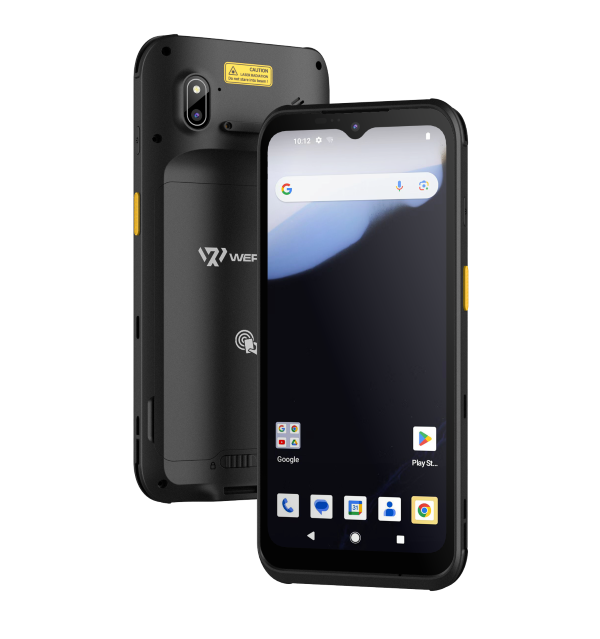
A major advantage of portable scanners is their versatility in terms of features. Depending on the model, they are available either with or without a screen. Models with a screen act as a personal digital assistant (PDA) and offer additional advanced functions such as displaying information, entering data directly or communicating with other systems. This not only makes it easier to scan barcodes, but also to manage and process data in real time.
Furthermore, portable scanners are often equipped with additional accessories that allow them to be attached to work clothing or tools. This ensures greater freedom of movement and increases efficiency, as the scanner is always within easy reach.
Areas of application for portable scanners
The possible uses of portable scanners are diverse and cover a wide range of industries and applications:
- Logistics: In logistics, portable scanners are often used to scan goods, products and items. They enable information to be captured quickly and accurately, making warehouse management and the dispatch of goods much easier.
- Public sector: Portable scanners are also used in the public sector. Soldiers and police officers use these devices to capture data that is necessary for their daily tasks, for example when scanning ID documents or recording evidence.
- Postal dispatch: Portable scanners with screens are particularly important in the postal dispatch sector. They are used to scan parcels and store the relevant information, which speeds up the shipping process and ensures the traceability of consignments.
With their robust design, flexible handling and the possibility of data integration, portable scanners offer a valuable solution for many areas of work where speed and precision are essential.
Advantages of portable scanners:
- Versatility: portable scanners can be used for scanning in logistics, production, public services or inventory management
- Portability: These devices are light and small enough to attach to work clothing
- Ultra Rugged: Depending on the model, the portable scanners are extremely robust and built for the most demanding environment
- Different versions: Portable scanners are available with and without a built-in screen, depending on use they can usually be connected wirelessly to an external device
- High performance: Portable scanners often have extremely long battery life and very good scan engines
- Easy maintenance: Due to the robustness of the scanners, they are not prone to problems and have a long service life
- Price: Conventional portable scanners are often available for a low price
Disadvantages:
- Limited working speed: The workflow is interrupted by picking up the scanner – hands are not free during, as well as immediately before and after the scanning process
Examples of portable scanners:
The Rockscan PX3000 impresses with its compact and ultra-robust design for all industrial applications. Tested according to protection class IP68, it is extremely robust and at the same time extremely powerful. Find out more about our powerful scanner here: Link
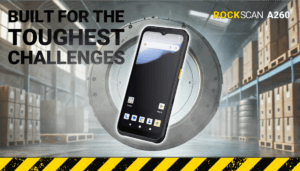
The Rockscan A260 is a robust PDA that impresses with its long battery life and large scanning range. In the ergonomic style of a smartphone, it scores with a large multi-touch display, seamless connectivity via 4G and a modern Android operating system. Find out more about the WEROCK PDAs here
Conclusion
Depending on the specific requirements of the working environment, both hand-held back scanners and portable scanners offer their respective advantages and disadvantages.
Back of hand scanners are characterised by their high efficiency and flexibility. They enable hands-free scanning, which is particularly advantageous in situations where hands are needed for other tasks. These scanners offer a fast, uncomplicated way of capturing barcodes and support increased freedom of movement. Their suitability for fast processes and high flexibility makes them ideal for use in environments where speed and convenience are required.
Handheld scanners, on the other hand, offer a robust solution for the most demanding environments. They are particularly suitable for use in challenging working conditions, for example in industry or logistics. The advantage of a portable scanner is that it has a display in the form of a PDA, which enables immediate control of the scanned data. This function is particularly useful when a precise check of the information is required before the capture is finalised.
To summarise, the choice between handheld and portable scanners depends on the requirements in terms of flexibility, efficiency and data transparency. Hand-held back scanners offer maximum flexibility and convenience, while portable scanners offer robustness and additional control options.